GS-ICP SLAM
GS-ICP SLAM 讓追蹤與建圖共用同一張三維高斯地圖:追蹤端把目前深度影像降採樣反投影後,以 k 近鄰共變異數組成來源高斯,再用廣義 ICP(G-ICP)與地圖中的目標高斯配準求得位姿;建圖端則直接沿用這些共變異數作為新增高斯的初始形狀,並依深度做尺度正規化,因此不需 3DGS 的密化步驟。系統另把追蹤關鍵影格與僅供建圖的關鍵影格分開,以兼顧軌跡精度與渲染品質;整體速度最高達每秒 107 影格,但沒有迴圈閉合,也未評估三維幾何精度。
本頁內容
RGB-D SLAM that tracks with G-ICP against the covariances of a single shared 3D Gaussian map and seeds new Gaussians with the G-ICP covariances (depth-normalized scale), reaching up to 107 FPS; no loop closure and no geometric accuracy evaluation.
技術屬性
欄位內容為文獻擷取紀錄的原文用語(英文),以原文為據;「未查證」表示本研究尚未讀到該資訊,不代表該方法不具備此能力。
| 感測輸入 | RGB-D camera |
|---|---|
| 原文測試平台 | simulation (Replica synthetic scenes)、原文未報告 (TUM RGB-D capture platform not described) |
| 狀態估計 | Generalized-ICP (G-ICP) scan-to-map registration: maximum-likelihood alignment of source Gaussians from the downsampled, reprojected depth image to target Gaussians taken from the 3DGS map, with ellipse scale regularization; 3DGS mapping runs in parallel with L1 and D-SSIM colour and L1 depth losses (Sec. 3, Eq. 1-3); the G-ICP module is built on the VGICP C++ implementation (Koide et al., 2021b) wrapped with pybind11 (ECCV Supp. Sec. A) |
| 資料關聯 | nearest-neighbour correspondences between source and target Gaussians inside G-ICP; keyframes selected when the share of correspondences within a distance threshold falls below a threshold, plus mapping-only keyframes every 10 frames (Sec. 3.1-3.2) |
| 時間表示 | discrete poses |
| 去畸變 | 不適用 |
| 迴圈閉合 | none |
| 全域最佳化 | none; mapping trains on one randomly chosen past keyframe per iteration and prunes degenerate Gaussians, but poses are not re-optimized globally (Sec. 3.2) |
| 地圖表示 | single 3D Gaussian map shared by tracking and mapping: new Gaussians inherit G-ICP k-nearest-neighbour covariances with depth-dependent scale normalization (divided by z^p, p = 1.5 best), without densification (Sec. 3.2, Tables 6 and 8) |
| 先驗資訊 | none; geometry comes from the sensor depth only (Sec. 5) |
| 可輸出幾何 | 3D Gaussian map rendered to colour and depth; the main text evaluates trajectory (ATE) and rendering (PSNR, SSIM, LPIPS) only (Sec. 4.1); the ECCV supplementary adds average rendered-depth L1 error of 0.030 m on Replica and 0.118 m on TUM, with no mesh or point-cloud accuracy against a reference (Supp. Sec. C.2) |
| 計算需求 | AMD Ryzen 7 7800X3D, 32 GB RAM, NVIDIA RTX 4090 24 GB; whole system up to 107 FPS (average 98.11 FPS on Replica, 73.92 FPS on TUM) without tracking limit, or capped at 30 FPS (Sec. 4.1, Tables 3-4) |
使用設備
原文使用的感測器、運算硬體與載具(equipment)。型號保留原文寫法,連結到設備頁中同一型號的歸併名稱;角色依原文用途分為方法輸入、資料集感測器、執行運算平台、參考或真值量測(reference or ground truth)與比較對象設備。
| 類別 | 型號(原文寫法) | 角色 | 資料集 | 原文規格 | 出處 |
|---|---|---|---|---|---|
| 運算硬體 | Ryzen 7 7800x3d | 執行運算平台 | 未標示 | CPU, desktop with 32GB RAM | (Ha et al., 2024, Sec. 4.1) |
| 運算硬體 | NVIDIA RTX 4090 24GB | 執行運算平台 | 未標示 | 24 GB GPU | (Ha et al., 2024, Sec. 4.1) |
論文圖片
只收錄原文以開放授權(open license)釋出的圖片,並依授權條件標示出處、圖號、授權與修改方式。
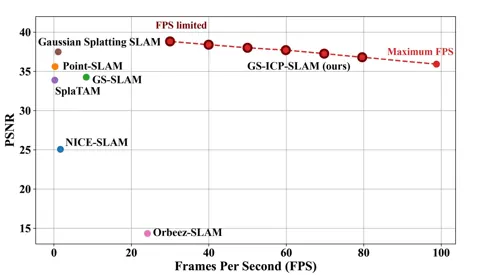
Fig. 1各稠密表示 SLAM 的影像品質(PSNR)與整體系統 FPS 比較圖
出處:Ha et al., 2024,Fig. 1。授權:CC BY 4.0 (arXiv v2 version of the figure; the ECCV version is published by Springer under exclusive licence)。原始圖檔。修改:縮小至寬度不超過 1400 px,並轉存為 WebP 格式。
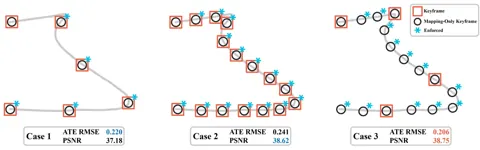
Fig. 4追蹤關鍵影格與僅供建圖關鍵影格分開選取的三種情境示意及其 ATE 與 PSNR
出處:Ha et al., 2024,Fig. 4。授權:CC BY 4.0 (arXiv v2 version of the figure; the ECCV version is published by Springer under exclusive licence)。原始圖檔。修改:縮小至寬度不超過 1400 px,並轉存為 WebP 格式。
作者報告的優勢與限制
優勢
- Replica average ATE RMSE 0.16 cm versus 0.36 cm for SplaTAM and 0.50 cm for GS-SLAM (Table 1)
- Whole-system speed up to 107 FPS on Replica (average 98.11 FPS) and 73.92 FPS on TUM without a tracking limit (Tables 3-4)
- TUM average ATE 2.4 cm, the lowest among coupled single-map methods in arXiv v2 Table 2; the ECCV version adds Gaussian Splatting SLAM (MonoGS, keyframes only) at 1.5 cm, so GS-ICP is described there as competitive (ECCV Table 1)
- Reusing G-ICP covariances for new Gaussians cuts Replica ATE from 8.893 to 0.157 cm in the ablation (Table 6)
限制
- Relies solely on depth for 3D structure, so map quality in real environments is limited by RGB-D depth noise (Sec. 5)
- On TUM, PSNR is about 11.7% lower than SplaTAM, and decoupled ORB-SLAM3 and Photo-SLAM track better (1.3 cm versus 2.4 cm) (Sec. 4.2-4.3, Tables 2 and 4)
- Without bundle adjustment its rendered-depth quality is lower than GS-SLAM (Replica depth L1 0.030 m versus 0.012 m reported by GS-SLAM) (ECCV Supp. Sec. C.2)
- Adding many tracking keyframes degrades accuracy through accumulated scan-matching error (Sec. 3.2, Table 7)
- No loop closure, and the main text assesses map quality by rendering metrics only (Sec. 3-4) (inference)
營建工程相關證據
論文正文只在 Replica 與 TUM RGB-D 驗證,未涉及營建場域,地圖品質僅以渲染指標評估;ECCV 補充資料另報告渲染深度的平均 L1 誤差為 Replica 0.030 m、TUM 0.118 m,仍不是對獨立參考的網格或點雲精度。其追蹤核心是點雲配準中的 G-ICP (Segal et al., 2009),實作建立在 VGICP (Koide et al., 2021b)上,與雷射 SLAM 的掃描配準一脈相承;語料中的地下工程與室內數位孿生研究以它為 3DGS 基準,包括 Yan et al., 2026b 的地下 RGB-D 實測資料(Table III)與 TUM(Table VI),以及 Yuan et al., 2026(Table 3)。作者也承認深度雜訊會限制真實場景的地圖品質。
原文驗證環境:公開基準、模擬
報告的性能數據
性能數據仍在分批查證,目前尚未收錄此方法的報告值。
來源
Ha et al., 2024
(2024)RGBD GS-ICP SLAMComputer Vision - ECCV 2024 (Lecture Notes in Computer Science), pp. 180-197
DOI 10.1007/978-3-031-72764-1_11arXiv 2403.12550程式碼
同儕審查已出版已讀全文近十年查證後修正
相關版本
- 預印本:arXiv:2403.12550v2 https://arxiv.org/abs/2403.12550
- 程式碼釋出:Lab-of-AI-and-Robotics/GS_ICP_SLAM https://github.com/Lab-of-AI-and-Robotics/GS_ICP_SLAM
- supplementary material:ECCV 2024 electronic supplementary material (implementation details, speed sweep, geometric quality) https://media.springernature.com/original/springer-static/esm/chp%3A10.1007%2F978-3-031-72764-1_11/MediaObjects/635169_1_En_11_MOESM1_ESM.pdf
程式碼:https://github.com/Lab-of-AI-and-Robotics/GS_ICP_SLAM(授權:MIT (LICENSE file checked))。有公開程式碼不等於已被重現,也不代表目前版本與論文版本相同。