4D iRIOM
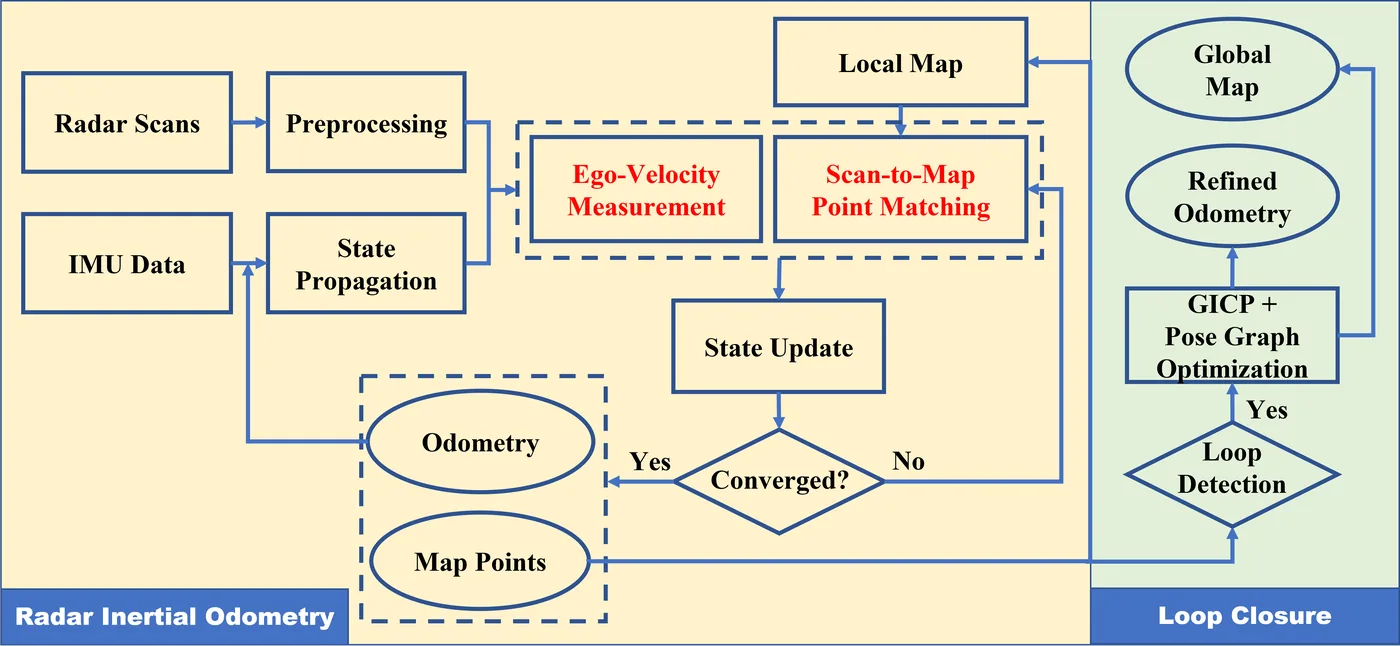
4D iRIOM 以 4D 成像雷達加 IMU 做里程計與建圖:每張雷達掃描先用漸進非凸(GNC)方法估計自身速度,排除移動物與多路徑造成的離群點,再把稀疏雷達點與局部子地圖的多個鄰近點以協方差加權配準;兩類量測都送入迭代擴展卡爾曼濾波器更新。最後以 scancontext 偵測回訪並建立位姿圖做迴圈閉合,得到全域一致的雷達點雲地圖。作者指出 LiDAR 與相機在雨、霧等劣化環境表現下降,毫米波雷達則能在霧中量測距離、方向與都卜勒速度。
本頁內容
Radar-inertial odometry and mapping with a 4D imaging radar: GNC-based ego-velocity from each scan plus distribution-to-multi-distribution scan-to-submap matches fused in an iterated EKF, with scancontext loop closure and pose graph optimization for a consistent radar map.
技術屬性
欄位內容為文獻擷取紀錄的原文用語(英文),以原文為據;「未查證」表示本研究尚未讀到該資訊,不代表該方法不具備此能力。
| 感測輸入 | 4D imaging radar (Continental ARS548)、IMU (EPSON G345 inside the Bynav X1-5H GNSS/INS) |
|---|---|
| 原文測試平台 | ["ground robot (drive type not stated in the text)", "ColoRadar dataset sequences"] |
| 狀態估計 | iterated extended Kalman filter with IMU propagation; state includes radar-IMU extrinsics and gravity; updates from radar ego-velocity and from scan-to-submap point matches; loop closure by scancontext detection with GICP constraints in a pose graph (Sec. III) |
| 資料關聯 | ego-velocity estimated from each radar scan by graduated non-convexity (GNC) with outlier relaxation and chi-square pruning at significance 0.05; scan-to-submap matching of sparse radar points against N = 5 nearest submap points weighted by covariance (distribution-to-multi-distribution) in an incrementally updated map (Sec. III) |
| 時間表示 | discrete radar scans (about 15 Hz) with IMU propagation between scans; inputs are time-aligned radar scans and 6D IMU data (Sec. III-A) |
| 去畸變 | not described |
| 迴圈閉合 | yes, scancontext place recognition with a descriptor threshold tuned for 4D radar; GICP relative constraints (Sec. III) |
| 全域最佳化 | pose graph optimization with relative pose and loop constraints (Sec. III) |
| 地圖表示 | radar point submap for scan-to-submap matching; global radar point map after pose graph optimization (Figs. 1, 5) |
| 先驗資訊 | none; radar-IMU extrinsics are part of the state |
| 可輸出幾何 | robot trajectory and sparse radar point cloud map |
| 計算需求 | real time on a consumer laptop for about 15 Hz radar scans; mean total 13.41 to 50.77 ms per scan, dominated by scan-to-submap matching (Table II) |
使用設備
原文使用的感測器、運算硬體與載具(equipment)。型號保留原文寫法,連結到設備頁中同一型號的歸併名稱;角色依原文用途分為方法輸入、資料集感測器、執行運算平台、參考或真值量測(reference or ground truth)與比較對象設備。
| 類別 | 型號(原文寫法) | 角色 | 資料集 | 原文規格 | 出處 |
|---|---|---|---|---|---|
| LiDAR | VLP-16歸入:Velodyne VLP-16 | 比較對象設備 | 4D iRIOM in-house radar dataset | LiDAR on the robot used by the FastLIO-SLAM baseline and for the sequence-3 reference | (Zhuang et al., 2023, Sec. IV-A) |
| 慣性量測單元(IMU) | G345 (built into Bynav X1-5H) | 方法輸入 | 4D iRIOM in-house radar dataset | gyroscope bias stability 0.00075 deg/s; angular random walk 0.003 deg/sqrt(s); accelerometer bias stability 70 ug; velocity random walk 0.0005 m/sqrt(s^3) | (Zhuang et al., 2023, Sec. IV-A) |
| GNSS 接收器 | X1-5H | 參考或真值量測 | 4D iRIOM in-house radar dataset | GNSS/INS reference in open-sky areas; about 3 cm with RTK, 25 cm after a 10 s RTK outage | (Zhuang et al., 2023, Sec. IV-A) |
| 雷達 | ARS548 | 方法輸入 | 4D iRIOM in-house radar dataset | 4D imaging radar; 15 Hz; 76-77 GHz; elevation AOV +-20 deg, azimuth AOV +-60 deg; azimuth resolution 0.2 deg, elevation resolution 0.1 deg; range about 300 m; distance accuracy 0.3 m | (Zhuang et al., 2023, Sec. IV-A) |
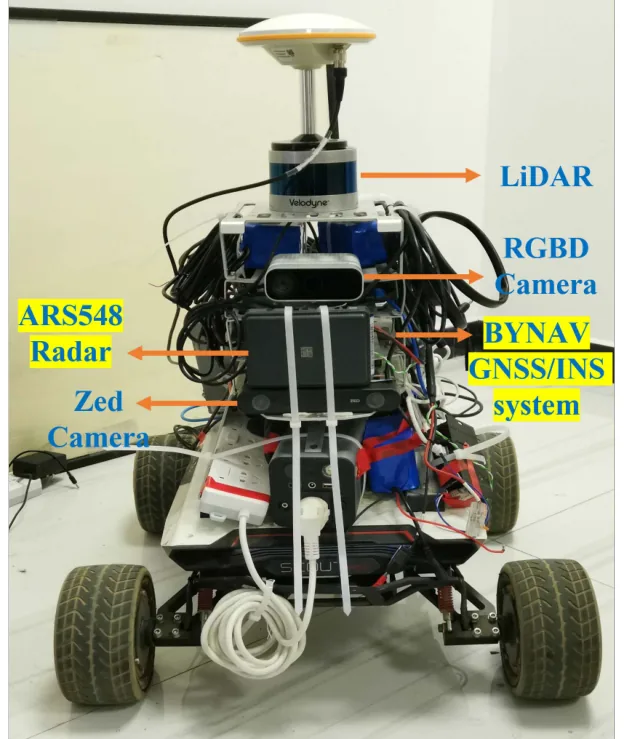
| 載具平台 | ground robot (drive type not stated) | 方法輸入 | 4D iRIOM in-house radar dataset | carries radar, GNSS/INS, LiDAR and cameras | (Zhuang et al., 2023, Fig. 3) |
| 運算硬體 | consumer laptop | 執行運算平台 | 4D iRIOM in-house radar dataset | real-time processing of about 15 Hz radar scans | (Zhuang et al., 2023, Sec. IV; Table II) |
論文圖片
只收錄原文以開放授權(open license)釋出的圖片,並依授權條件標示出處、圖號、授權與修改方式。
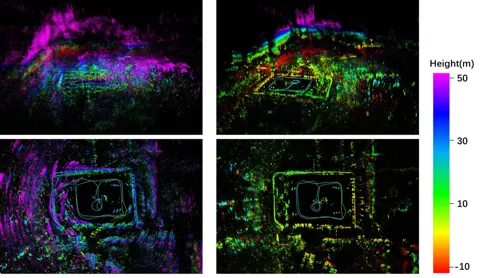
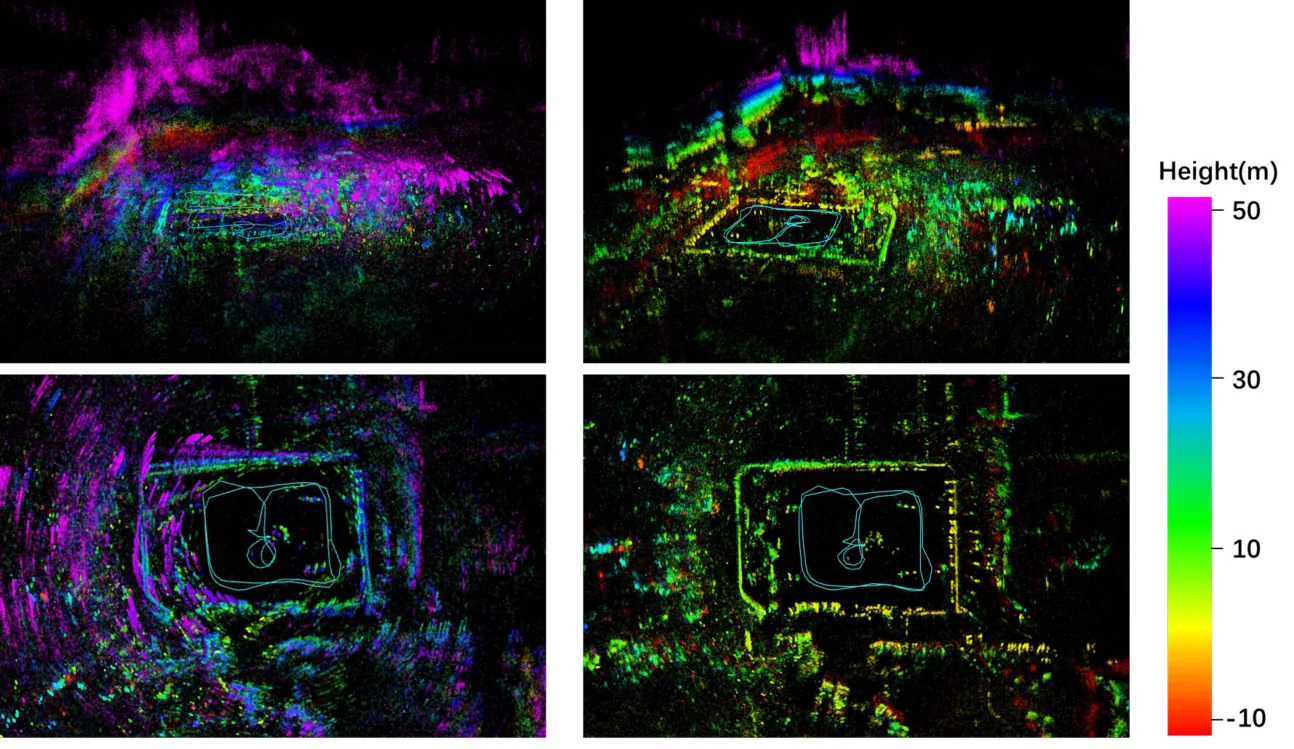
Fig. 1籃球場資料的 iRIOM 建圖結果:只用雷達自身速度與 IMU 時的地圖,對照再加入雷達點配準後的地圖
出處:Zhuang et al., 2023,Fig. 1。授權:CC BY 4.0。原始圖檔。修改:轉存為 WebP 格式。
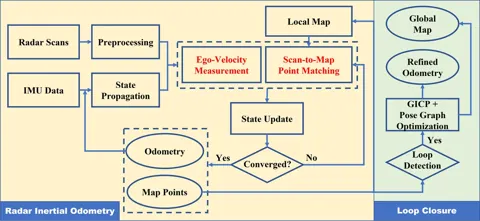
Fig. 2iRIOM 系統概觀:雷達點雲前處理、GNC 自身速度估計、掃描對子地圖配準、迭代 EKF 更新,以及 scancontext 迴圈閉合與位姿圖
出處:Zhuang et al., 2023,Fig. 2。授權:CC BY 4.0。原始圖檔。修改:縮小至寬度不超過 1400 px,並轉存為 WebP 格式。
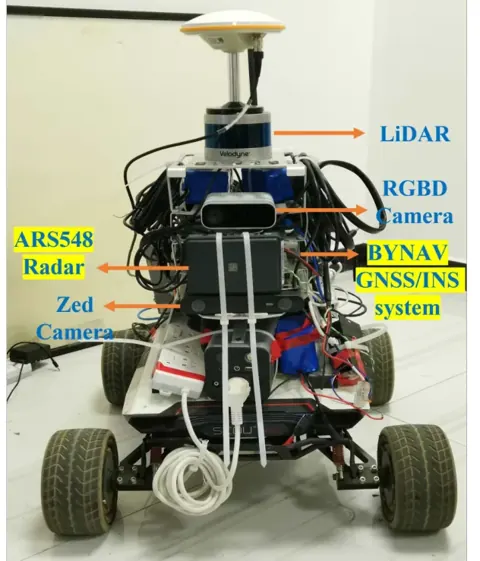
Fig. 3測試用地面機器人與感測器配置(ZED 相機與 RGB-D 相機未使用)
出處:Zhuang et al., 2023,Fig. 3。授權:CC BY 4.0。原始圖檔。修改:轉存為 WebP 格式。
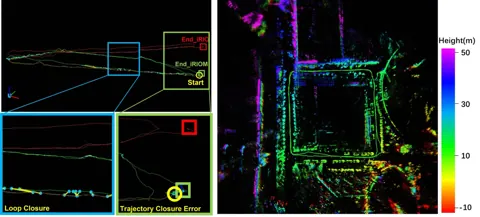
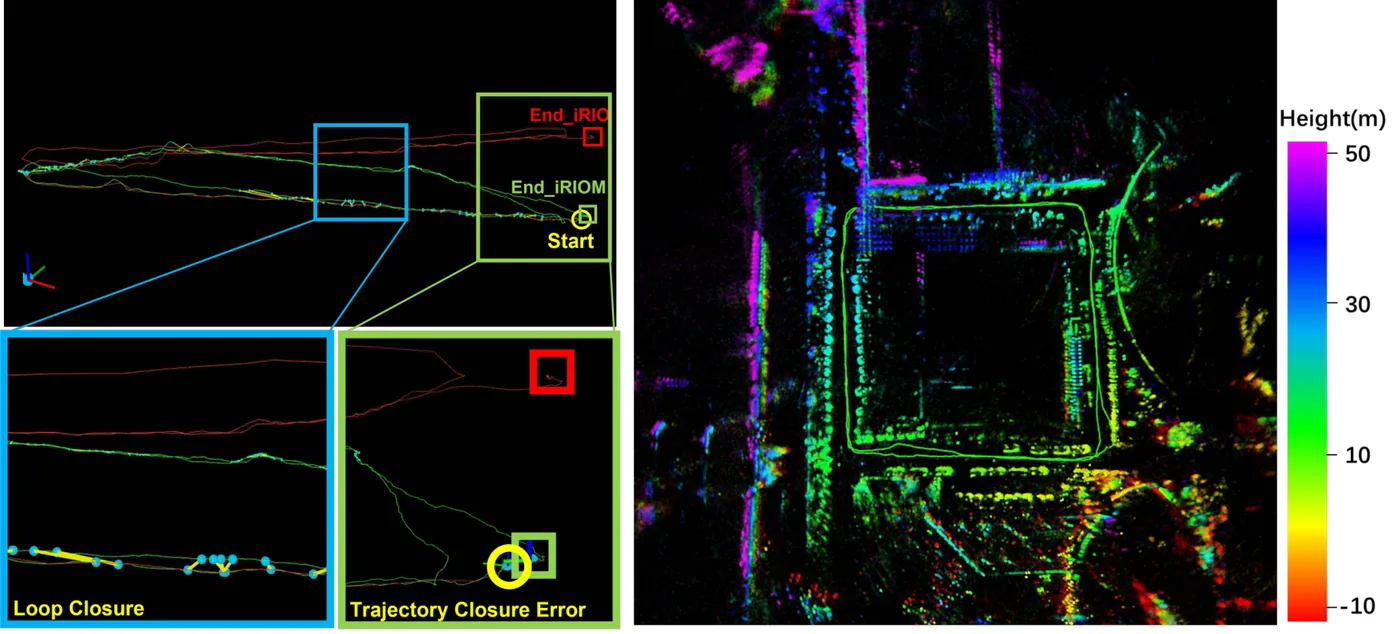
Fig. 5序列 2 偵測到的迴圈閉合與閉合誤差,以及 iRIOM 的建圖結果
出處:Zhuang et al., 2023,Fig. 5。授權:CC BY 4.0。原始圖檔。修改:縮小至寬度不超過 1400 px,並轉存為 WebP 格式。
作者報告的優勢與限制
優勢
- On three in-house sequences, APE translation RMSE 0.305 to 0.336 m for iRIOM versus 3.388 to 10.068 m for EKFRIO (Table I)
- Accuracy comparable to LiDAR-inertial FastLIO-SLAM on sequences 1-2, with lower APE rotation RMSE (Table I)
- Loop closure reduces vertical closure error on the two-lap building sequence from 5.073 m to 0.001 m (Table I)
- Ablations show that fusing both ego-velocity and scan-to-submap matches avoids failures seen with either alone or with a constant-velocity model (Table III)
- Real-time on a consumer laptop (Table II)
限制
- Radar scans are sparse (typically under 500 points) and noisy, so maps are sparse (Sec. III)
- Scan-to-submap matching is the costliest step, with maximum per-scan time up to 380 ms (Table II)
- Reference trajectory for the underground parking sequence comes from FastLIO-SLAM rather than GNSS/INS (Sec. IV-B)
- Code is not released in the paper
營建工程相關證據
施工現場常有粉塵、雨霧與照明不足;作者以雨霧中 LiDAR 與相機表現下降作為研究動機,本文可作為雷達慣性 SLAM 在劣化環境的代表方法(推論,論文未測試粉塵或施工現場)。測試場景包含校園建物周邊與地下停車場,但雷達點雲稀疏,只能提供定位與粗略地圖,無法取代 LiDAR 做點雲精度量測;論文也沒有施工現場資料。
原文驗證環境:獨立參考量測、公開基準、地下或隧道
報告的性能數據
以下是原文作者報告的性能數值(author-reported results),不是本研究重新量測的結果。每張圖只並列同一個比較組(comparison group,同一張表、同一組實驗設定)內的方法;不同比較組之間的數值不可直接比較,也不構成排名。
本方法共出現在 4 個比較組,合計 103 筆紀錄。
Zhuang et al., 2023 · Table I 本方法 36 筆
表格設定(擷取紀錄原文):In-house ground-robot sequences with ARS548 radar and EPSON G345 IMU; reference: Bynav X1-5H GNSS/INS for sequences 1-2 and FastLIO-SLAM (LiDAR-IMU) for sequence 3; closure errors are means of 10 runs; FastLIO = FastLIO-SLAM with loop closure using the VLP-16 (Zhuang et al., 2023, Table I)
Closure Error Hor,4D iRIOM in-house radar dataset · Seq. 1 (basketball court, 6 min)
只並列這張表在相同設定下報告的方法;以「本方法:」開頭者為本頁方法。失敗、未執行與未報告以標記呈現,不是 0。
按 Tab 進入圖表後,用上下方向鍵逐一瀏覽各類別,Esc 關閉提示框;也可開啟表格檢視閱讀全部數值。
這些是 Zhuang et al., 2023 在此表設定下報告的數值(author-reported results),只能在同一個比較組內對照,不代表方法在其他資料或設定下的表現。
資料來源作者報告值(Zhuang et al., 2023, Table I)
| 方法(原文寫法) | 報告值 | 出處 |
|---|---|---|
| EKFRIO | 0.53 m | (Zhuang et al., 2023, Table I; Sec. IV-B) |
| iRIO (without loop closure)本方法原文提出 | 0.029 m | (Zhuang et al., 2023, Table I; Sec. IV-B) |
| iRIOM本方法原文提出 | 0.027 m | (Zhuang et al., 2023, Table I; Sec. IV-B) |
| FastLIO (FastLIO-SLAM with loop closure) | 0.024 m | (Zhuang et al., 2023, Table I; Sec. IV-B) |
Zhuang et al., 2023 · Table II 本方法 36 筆
表格設定(擷取紀錄原文):Timing statistics of iRIOM (max / min and mean in ms) per radar scan on a consumer laptop (Zhuang et al., 2023, Table II)
IMU predict time,4D iRIOM in-house radar dataset · Seq. 1 (basketball court, 6 min)
這張表在此指標與資料序列只列出本方法一筆,沒有可並列的其他方法,因此不畫圖,數值與出處見下表。這是 Zhuang et al., 2023 在此表設定下報告的數值(author-reported results),不代表方法在其他資料或設定下的表現。
| 方法(原文寫法) | 報告值 | 出處 |
|---|---|---|
| iRIOM本方法原文提出硬體:consumer laptop (model not reported) | 10.66 ms | (Zhuang et al., 2023, Table II; Sec. IV) |
Zhuang et al., 2023 · Table IV 本方法 16 筆
表格設定(擷取紀錄原文):ColoRadar dataset sequences; closure error and APE RMSE of the radar methods against the dataset reference trajectory (Zhuang et al., 2023, Table IV)
Closure Error Hor,ColoRadar · 2_23_2021_edgar_classroom_run0
只並列這張表在相同設定下報告的方法;以「本方法:」開頭者為本頁方法。失敗、未執行與未報告以標記呈現,不是 0。
按 Tab 進入圖表後,用上下方向鍵逐一瀏覽各類別,Esc 關閉提示框;也可開啟表格檢視閱讀全部數值。
這些是 Zhuang et al., 2023 在此表設定下報告的數值(author-reported results),只能在同一個比較組內對照,不代表方法在其他資料或設定下的表現。
資料來源作者報告值(Zhuang et al., 2023, Table IV)
| 方法(原文寫法) | 報告值 | 出處 |
|---|---|---|
| EKFRIO | 15.732 m | (Zhuang et al., 2023, Table IV; Sec. IV-D) |
| iRIO (without loop closure)本方法原文提出 | 7.309 m | (Zhuang et al., 2023, Table IV; Sec. IV-D) |
| iRIOM本方法原文提出 | 0.351 m | (Zhuang et al., 2023, Table IV; Sec. IV-D) |
Zhuang et al., 2023 · Table III (failure counts) 本方法 15 筆
指標F (number of failures in 10 repetitions)
表格設定(擷取紀錄原文):Ablation on in-house sequences, number of failures F in 10 repetitions; Vel.: ego-velocity update only; S2M: scan-to-submap update only; Both: both updates (iRIO); CVM: constant velocity model replaces the IMU; S2S: scan-to-five-scans matching; error columns of this table omitted (row cap) (Zhuang et al., 2023, Table III (failure counts))
F (number of failures in 10 repetitions),4D iRIOM in-house radar dataset · Seq. 1 (basketball court, 6 min)
只並列這張表在相同設定下報告的方法;以「本方法:」開頭者為本頁方法。失敗、未執行與未報告以標記呈現,不是 0。
按 Tab 進入圖表後,用上下方向鍵逐一瀏覽各類別,Esc 關閉提示框;也可開啟表格檢視閱讀全部數值。
這些是 Zhuang et al., 2023 在此表設定下報告的數值(author-reported results),只能在同一個比較組內對照,不代表方法在其他資料或設定下的表現。
資料來源作者報告值(Zhuang et al., 2023, Table III (failure counts))
| 方法(原文寫法) | 報告值 | 出處 |
|---|---|---|
| iRIO variant: Vel.本方法原文提出 | 1 count | (Zhuang et al., 2023, Table III; Sec. IV-C) |
| iRIO variant: S2M本方法原文提出 | 4 count | (Zhuang et al., 2023, Table III; Sec. IV-C) |
| iRIO variant: Both本方法原文提出 | 0 count | (Zhuang et al., 2023, Table III; Sec. IV-C) |
| iRIO variant: CVM本方法原文提出 | 5 count | (Zhuang et al., 2023, Table III; Sec. IV-C) |
| iRIO variant: S2S本方法原文提出 | 2 count | (Zhuang et al., 2023, Table III; Sec. IV-C) |
來源
Zhuang et al., 2023
(2023)4D iRIOM: 4D Imaging Radar Inertial Odometry and MappingIEEE Robotics and Automation Letters, 8(6), pp. 3246-3253
DOI 10.1109/lra.2023.3266669arXiv 2303.13962
同儕審查已出版已讀全文近十年查證後修正
相關版本
- 預印本:4D iRIOM arXiv v2 (accepted, proofread version; CC BY 4.0) https://arxiv.org/abs/2303.13962v2