Scan Context++
Scan Context++ 擴充原 Scan Context,提出極座標的 Polar Context(處理航向旋轉)與直角座標的 Cart Context(處理側向平移)兩種描述子。流程分三段:以檢索鍵(retrieval key)建立 kd-tree 做地點檢索,以對齊鍵(aligning key)做 1 自由度半度量定位,最後以完整描述子比對剔除誤判;並以描述子增強同時應對旋轉與側移。方法假設橫滾與俯仰變化不劇烈。
本頁內容
Scan Context++ adds polar and Cartesian variants of the descriptor with retrieval and aligning sub-keys for three-stage place retrieval, 1-DoF semi-metric alignment and verification, robust to heading and lateral changes.
技術屬性
欄位內容為文獻擷取紀錄的原文用語(英文),以原文為據;「未查證」表示本研究尚未讀到該資訊,不代表該方法不具備此能力。
| 感測輸入 | 3D LiDAR、radar (extension discussed) |
|---|---|
| 原文測試平台 | vehicle (KITTI, MulRan, Oxford Radar RobotCar, NAVER LABS Pangyo)、handheld (KA Urban Campus 1 sequence from LiLi-OM, slowly walking operator) |
| 狀態估計 | 不適用 (integration example uses iSAM2 pose graph in SC-LeGO-LOAM, Sec. VII-F) |
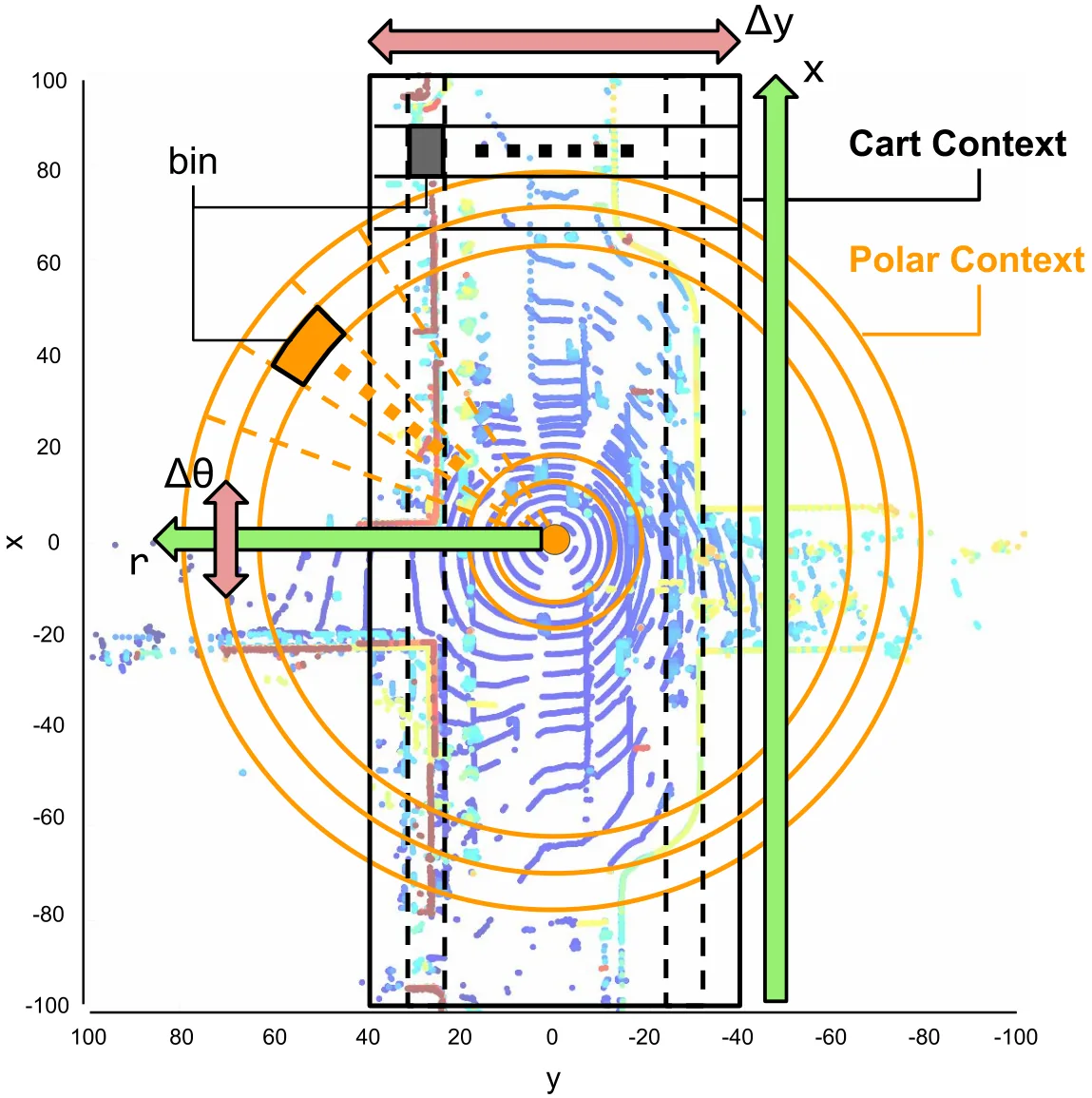
| 資料關聯 | Polar Context (20 x 60 bins over 0 to 80 m and 360 deg) and Cart Context (40 x 40 bins over -100 to 100 m by -40 to 40 m) with maximum-height bins after 0.5 m voxel downsampling; retrieval key = L1 norm per row (the IROS 2018 version used an L0 occupancy ratio) in a single k-d tree with k = 1 candidate; aligning key (L1 per column) gives the column shift by L2 matching; full-descriptor cosine distance only at that shift for verification; augmentation by +/-2 m lateral root shifts (A-PC) or a double flip (A-CC) |
| 時間表示 | 不適用 |
| 去畸變 | 原文未報告 |
| 迴圈閉合 | provides loop candidates plus 1-DoF initial alignment for ICP in a keyframe pose graph |
| 全域最佳化 | none (component); demonstrated with iSAM2 in SC-LeGO-LOAM |
| 地圖表示 | per-keyframe 2D descriptor database |
| 先驗資訊 | none; no odometry prior needed for retrieval (Sec. V-A, VII-F) |
| 可輸出幾何 | 不適用 |
| 計算需求 | single C++ header and source pair; on Intel i9-9900 3.10 GHz with 64 GB RAM inside the real-time SLAM, mean 7.36 ms per query on KITTI 00 and 7.31 ms on the 31 km Pangyo sequence, with periodic k-d tree rebuild as the most expensive step; Table V totals: PC 8.3 ms, A-PC 11.5 ms and M2DP 5.8 ms measured in Matlab, SegMatch 796.0 ms copied from its paper, PointNetVLAD 34.0 ms on a GTX 1080 Ti GPU |
使用設備
原文使用的感測器、運算硬體與載具(equipment)。型號保留原文寫法,連結到設備頁中同一型號的歸併名稱;角色依原文用途分為方法輸入、資料集感測器、執行運算平台、參考或真值量測(reference or ground truth)與比較對象設備。
| 類別 | 型號(原文寫法) | 角色 | 資料集 | 原文規格 | 出處 |
|---|---|---|---|---|---|
| LiDAR | Velodyne HDL-64E | 資料集感測器 | KITTI odometry | 64-ray, full HFOV | (Kim et al., 2022b, Sec. VI-A1; Table III) |
| LiDAR | Ouster OS1-64 | 資料集感測器 | MulRan | 64-ray, 290 deg usable HFOV in Table III | (Kim et al., 2022b, Sec. VI-A2; Table III) |
| LiDAR | Velodyne HDL-32E (two, left and right of the radar)歸入:Velodyne HDL-32E | 資料集感測器 | Oxford Radar RobotCar | 32-ray; scans concatenated into one cloud | (Kim et al., 2022b, Sec. VI-A3; Table III) |
| LiDAR | 原文未報告 (32-ray LiDAR) | 資料集感測器 | NAVER LABS (Pangyo) | 32-ray, full HFOV | (Kim et al., 2022b, Table III; Sec. VII-G) |
| LiDAR | 原文未報告 (hand-held LiDAR of the LiLi-OM KA Urban Campus 1 sequence) | 資料集感測器 | LiLi-OM KA Urban Campus 1 | narrow front horizontal FOV about 70 deg | (Kim et al., 2022b, Sec. VIII-D) |
| GNSS 接收器 | INS and GPS (model not stated) | 資料集感測器 | Oxford Radar RobotCar | sequences chosen where INS and GPS were available over the whole trajectory | (Kim et al., 2022b, Sec. VI-A3) |
| 運算硬體 | Intel i9-9900 CPU | 執行運算平台 | 未標示 | 3.10 GHz, 64 GB RAM | (Kim et al., 2022b, Sec. VII-G) |
| 運算硬體 | GTX 1080 Ti | 執行運算平台 | 未標示 | GPU used for PointNetVLAD timing | (Kim et al., 2022b, Sec. VII-G; Table V) |
論文圖片
只收錄原文以開放授權(open license)釋出的圖片,並依授權條件標示出處、圖號、授權與修改方式。
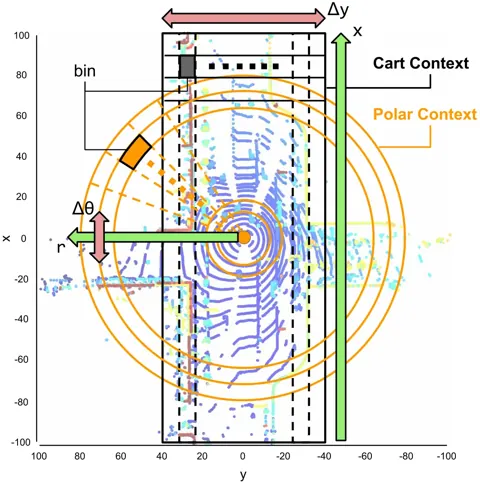
Fig. 3(a)樣本點雲上 Polar Context(黃色)與 Cart Context(灰色)的分格方式,紅色箭頭為對齊軸,綠色箭頭為檢索軸。
出處:Kim et al., 2022b,Fig. 3(a)。授權:CC BY-NC-SA 4.0。原始圖檔。修改:轉存為 WebP 格式。
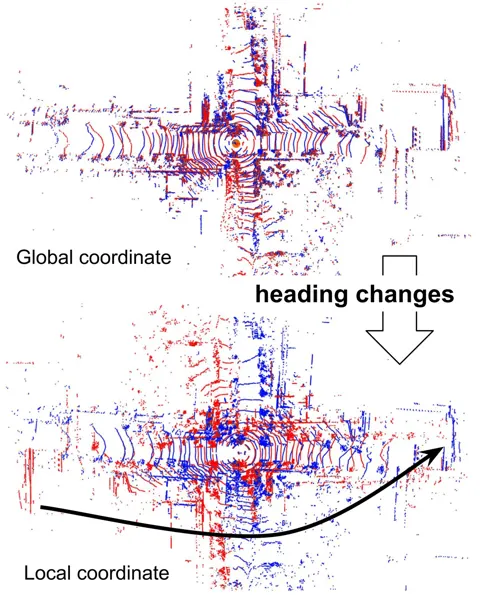
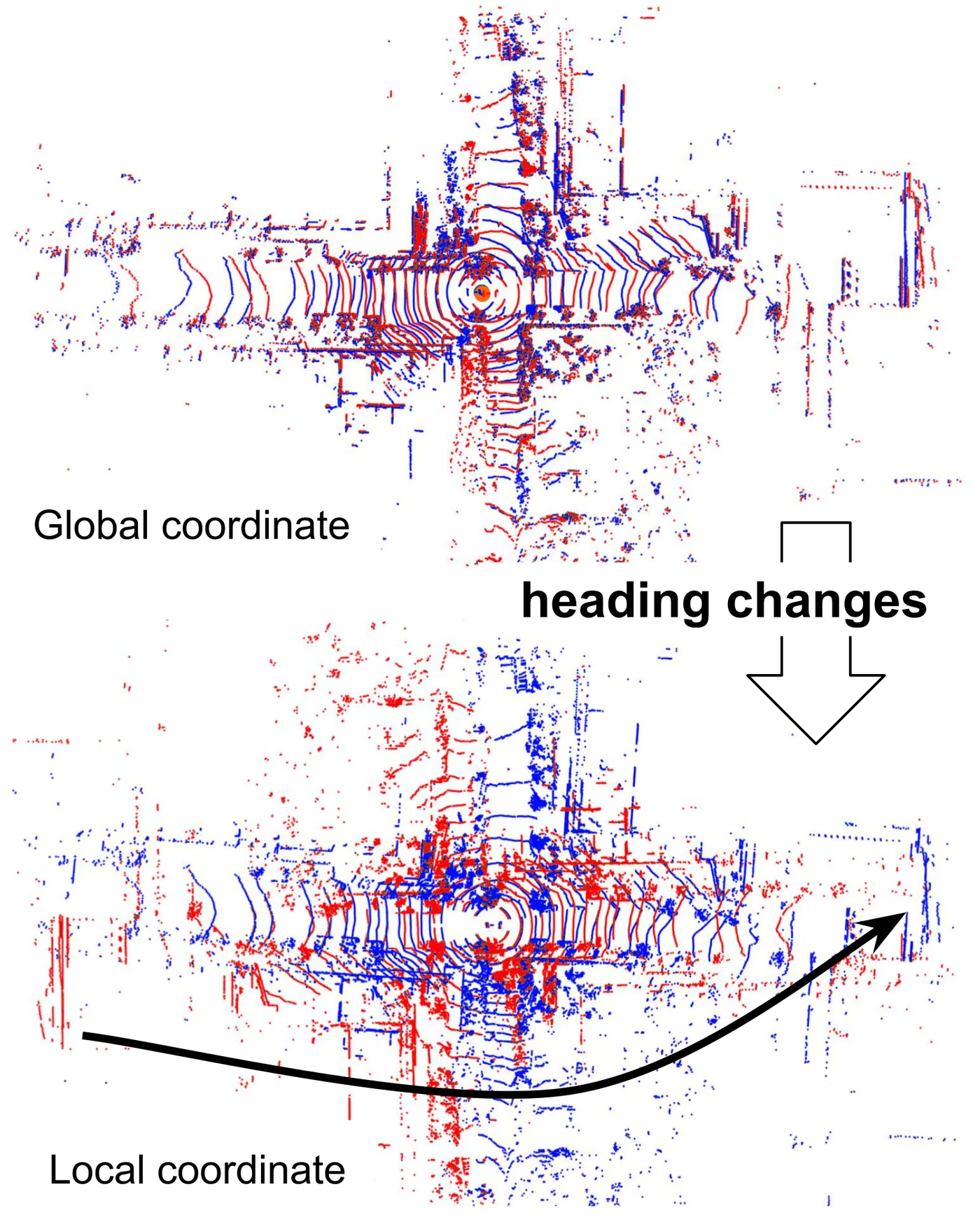
Fig. 1(a)反向重訪造成的旋轉位移:世界座標與感測器座標下的查詢與資料庫掃描比較。
出處:Kim et al., 2022b,Fig. 1(a)。授權:CC BY-NC-SA 4.0。原始圖檔。修改:縮小至寬度不超過 1400 px,並轉存為 WebP 格式。
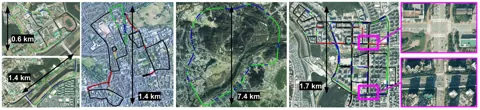
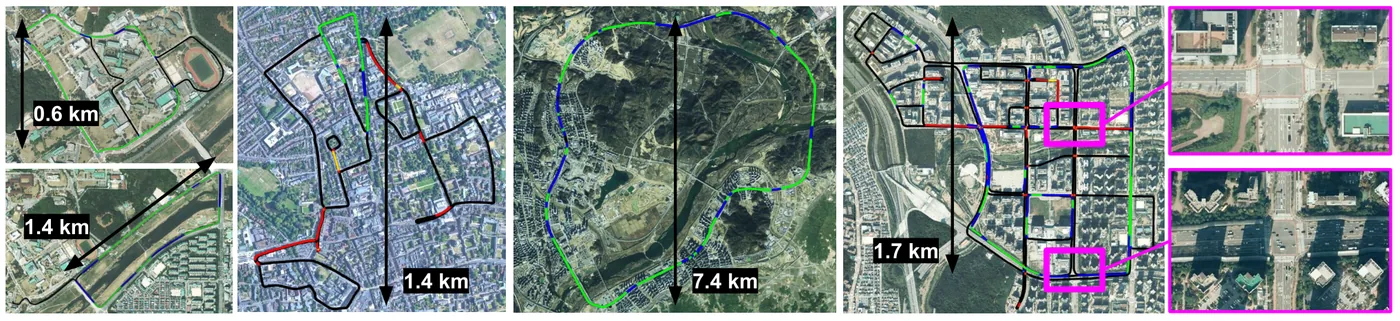
Fig. 6MulRan、Oxford Radar RobotCar 與 NAVER LABS 各序列軌跡疊合於航照圖。
出處:Kim et al., 2022b,Fig. 6。授權:CC BY-NC-SA 4.0。原始圖檔。修改:縮小至寬度不超過 1400 px,並轉存為 WebP 格式。
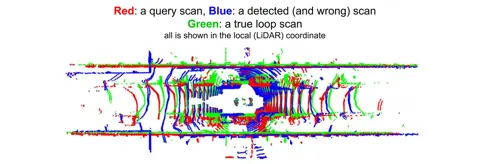
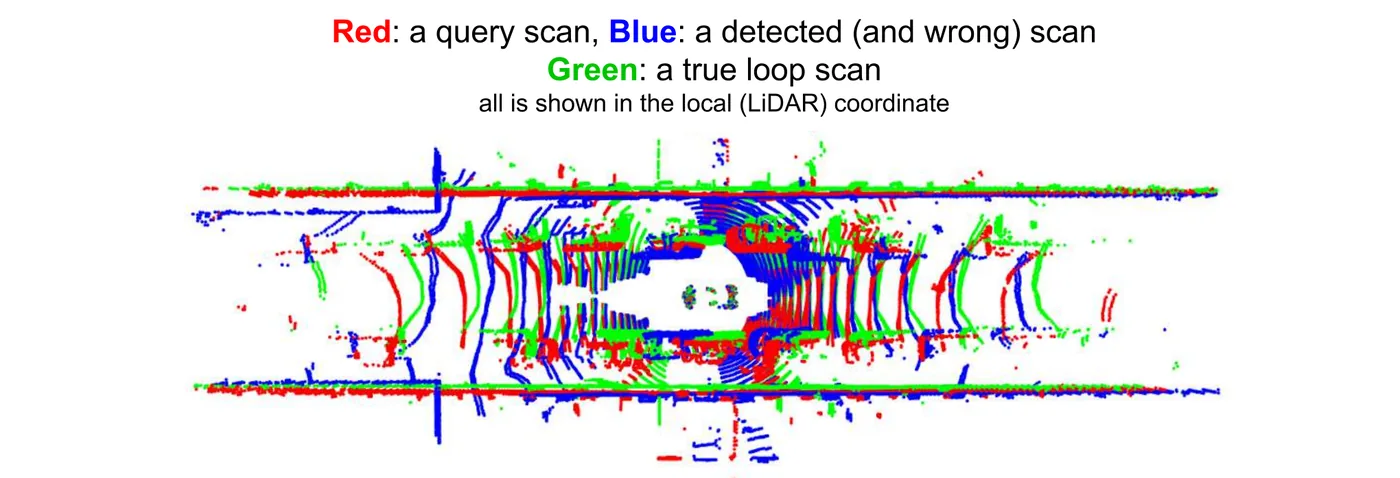
Fig. 22(b)失效案例:車輛沿走廊狀場所行駛造成的感知混淆。
出處:Kim et al., 2022b,Fig. 22(b)。授權:CC BY-NC-SA 4.0。原始圖檔。修改:縮小至寬度不超過 1400 px,並轉存為 WebP 格式。
作者報告的優勢與限制
優勢
- Global retrieval without odometry prior; lightweight and easy to add to keyframe pose-graph SLAM (Sec. V-A, VII-F)
- Evaluated across KITTI, MulRan, Oxford Radar RobotCar and NAVER LABS data (Sec. VI-A)
- Multi-session place recognition with temporal gaps, including a two-month gap on MulRan Sejong (Sec. VII-D)
- SC-LeGO-LOAM reduced mean translational ATE from 20.7 m to 3.4 m on KAIST 03 and from 47.7 m to 15.2 m on Riverside 02 relative to LeGO-LOAM (Table IV)
- Semi-metric 1-DoF alignment errors of 1.03 deg (A-PC) and 0.84 m (A-CC) on Pangyo (Sec. VII-E)
- On a hand-held sequence with mild roll, pitch and height perturbation it outperformed M2DP by a large margin (Sec. VIII-D)
限制
- Assumes roll-pitch motions are not severe (abstract); random roll and pitch pre-rotations of +/-5, +/-10 and +/-15 deg caused clear performance losses for PC, CC and M2DP (Sec. VIII-D, Fig. 20)
- Failure cases shown on driving data: the vehicle moving along a corridor-like place, and a tall, large object (e.g., a bus) very close to the sensor in both query and map scans (Sec. VIII-F, Fig. 22)
- Most powerful in urban environments; indoor and natural environments may need extra channels such as intensity or semantics (Sec. VIII-H3)
- Heterogeneous LiDAR setups (e.g. different mounting height between mapper and localizer) declared out of scope; generalization across hardware and mounting left open (Sec. IV-C, VIII-H5)
- Each descriptor is natively invariant in only one direction (Sec. VIII-H1); without augmentation PC is weaker under lateral change (Riverside 02 AUC 0.72 vs 0.88 for CC) and CC fails on reverse revisits (KITTI 08 AUC 0.00) (Table VIII, IX; Sec. VII-B)
營建工程相關證據
未於工地測試;作者明言方法最適合都市結構環境(Sec. VIII-H3),其失效案例為車載資料中沿「走廊狀場所」行駛及公車等高大物體緊貼感測器(Sec. VIII-F),並非室內走廊實驗。作者另以步行手持光達序列 KA Urban Campus 1 測試,結果優於 M2DP,並認為溫和的橫滾、俯仰與高度擾動可接受;但以 ±5° 至 ±15° 隨機預旋轉模擬時,各方法效能皆明顯下降(Sec. VIII-D、Fig. 20)。營建室內走廊、重複樓層與遮蔽嚴重的材料堆放區是否同樣失效屬推論,尚無直接證據;非商用授權(CC BY-NC-SA 4.0)限制工程部署。
原文驗證環境:公開基準、跨場域
報告的性能數據
以下是原文作者報告的性能數值(author-reported results),不是本研究重新量測的結果。每張圖只並列同一個比較組(comparison group,同一張表、同一組實驗設定)內的方法;不同比較組之間的數值不可直接比較,也不構成排名。
本方法共出現在 6 個比較組,合計 66 筆紀錄。以下列出本方法紀錄最多的 4 組,其餘 2 組列在最後,並連到性能比較頁。
Kim et al., 2022b · Table IX 本方法 32 筆
表格設定(擷取紀錄原文):AUC with respect to correctness threshold (baseline 8 m) (Kim et al., 2022b, Table IX)
AUC at correctness threshold 8 m,KITTI odometry · KITTI 00 (threshold 8 m)
只並列這張表在相同設定下報告的方法;以「本方法:」開頭者為本頁方法。失敗、未執行與未報告以標記呈現,不是 0。
按 Tab 進入圖表後,用上下方向鍵逐一瀏覽各類別,Esc 關閉提示框;也可開啟表格檢視閱讀全部數值。
這些是 Kim et al., 2022b 在此表設定下報告的數值(author-reported results),只能在同一個比較組內對照,不代表方法在其他資料或設定下的表現。
資料來源作者報告值(Kim et al., 2022b, Table IX)
| 方法(原文寫法) | 報告值 | 出處 |
|---|---|---|
| Polar Context (PC)本方法原文提出 | 0.84 ratio | (Kim et al., 2022b, Table IX) |
| Cart Context (CC)本方法原文提出 | 0.81 ratio | (Kim et al., 2022b, Table IX) |
Kim et al., 2022b · Table VIII 本方法 16 筆
指標AUC (area under precision-recall curve)
表格設定(擷取紀錄原文):AUC of precision-recall: retrieval key (k-d tree, k = 1) vs brute-force full descriptor search; 8 m correctness threshold (Kim et al., 2022b, Table VIII)
AUC (area under precision-recall curve),KITTI odometry · KITTI 00
只並列這張表在相同設定下報告的方法;以「本方法:」開頭者為本頁方法。失敗、未執行與未報告以標記呈現,不是 0。
按 Tab 進入圖表後,用上下方向鍵逐一瀏覽各類別,Esc 關閉提示框;也可開啟表格檢視閱讀全部數值。
這些是 Kim et al., 2022b 在此表設定下報告的數值(author-reported results),只能在同一個比較組內對照,不代表方法在其他資料或設定下的表現。
資料來源作者報告值(Kim et al., 2022b, Table VIII)
| 方法(原文寫法) | 報告值 | 出處 |
|---|---|---|
| Polar Context (PC), retrieval key本方法原文提出 | 0.84 ratio | (Kim et al., 2022b, Table VIII) |
| Polar Context (PC), full descriptor本方法原文提出 | 0.85 ratio | (Kim et al., 2022b, Table VIII) |
| Cart Context (CC), retrieval key本方法原文提出 | 0.8 ratio | (Kim et al., 2022b, Table VIII) |
| Cart Context (CC), full descriptor本方法原文提出 | 0.34 ratio | (Kim et al., 2022b, Table VIII) |
Kim et al., 2022b · Table IV 本方法 8 筆
表格設定(擷取紀錄原文):ATE (mean / max) of LeGO-LOAM odometry vs Scan Context integrated SC-LeGO-LOAM (iSAM2 pose graph) (Kim et al., 2022b, Table IV)
ATE Trans. mean,MulRan · KAIST 03
只並列這張表在相同設定下報告的方法;以「本方法:」開頭者為本頁方法。失敗、未執行與未報告以標記呈現,不是 0。
按 Tab 進入圖表後,用上下方向鍵逐一瀏覽各類別,Esc 關閉提示框;也可開啟表格檢視閱讀全部數值。
這些是 Kim et al., 2022b 在此表設定下報告的數值(author-reported results),只能在同一個比較組內對照,不代表方法在其他資料或設定下的表現。
資料來源作者報告值(Kim et al., 2022b, Table IV)
| 方法(原文寫法) | 報告值 | 出處 |
|---|---|---|
| LeGO-LOAM | 20.7 m | (Kim et al., 2022b, Table IV) |
| SC-LeGO-LOAM本方法原文提出 | 3.4 m | (Kim et al., 2022b, Table IV) |
Kim et al., 2022b · Table V 本方法 6 筆
資料集與序列原文未報告
表格設定(擷取紀錄原文):Time cost per query in ms; ours and M2DP measured in Matlab, SegMatch copied from its paper, PointNetVLAD on GPU (Kim et al., 2022b, Table V)
Description time,原文未報告
只並列這張表在相同設定下報告的方法;以「本方法:」開頭者為本頁方法。失敗、未執行與未報告以標記呈現,不是 0。
按 Tab 進入圖表後,用上下方向鍵逐一瀏覽各類別,Esc 關閉提示框;也可開啟表格檢視閱讀全部數值。
這些是 Kim et al., 2022b 在此表設定下報告的數值(author-reported results),只能在同一個比較組內對照,不代表方法在其他資料或設定下的表現。
資料來源作者報告值(Kim et al., 2022b, Table V)
| 方法(原文寫法) | 報告值 | 出處 |
|---|---|---|
| Ours (PC)本方法原文提出硬體:Matlab, CPU (machine not stated for Table V) | 1.6 ms | (Kim et al., 2022b, Table V) |
| Ours (A-PC)本方法原文提出硬體:Matlab, CPU (machine not stated for Table V) | 4.8 ms | (Kim et al., 2022b, Table V) |
| M2DP硬體:Matlab, CPU (machine not stated for Table V) | 4.3 ms | (Kim et al., 2022b, Table V) |
| SegMatch硬體:values copied from the SegMatch paper | 430.2 ms | (Kim et al., 2022b, Table V) |
| PointNetVLAD硬體:GPU (GTX 1080 Ti) | 33.3 ms | (Kim et al., 2022b, Table V) |
其他比較組
來源
Kim et al., 2022b
(2022)Scan Context++: Structural Place Recognition Robust to Rotation and Lateral Variations in Urban EnvironmentsIEEE Transactions on Robotics, 38(3):1856-1874
DOI 10.1109/tro.2021.3116424arXiv 2109.13494程式碼
同儕審查已出版已讀全文近十年查證後修正
相關版本
- 會議版:Scan Context (IROS 2018) - predecessor extended by this paper 10.1109/IROS.2018.8593953
- 程式碼釋出:gisbi-kim/scancontext; SC-LeGO-LOAM integration https://github.com/gisbi-kim/scancontext
程式碼:https://github.com/gisbi-kim/scancontext(授權:CC BY-NC-SA 4.0 (stated in README; non-commercial))。有公開程式碼不等於已被重現,也不代表目前版本與論文版本相同。