Mesh-LOAM
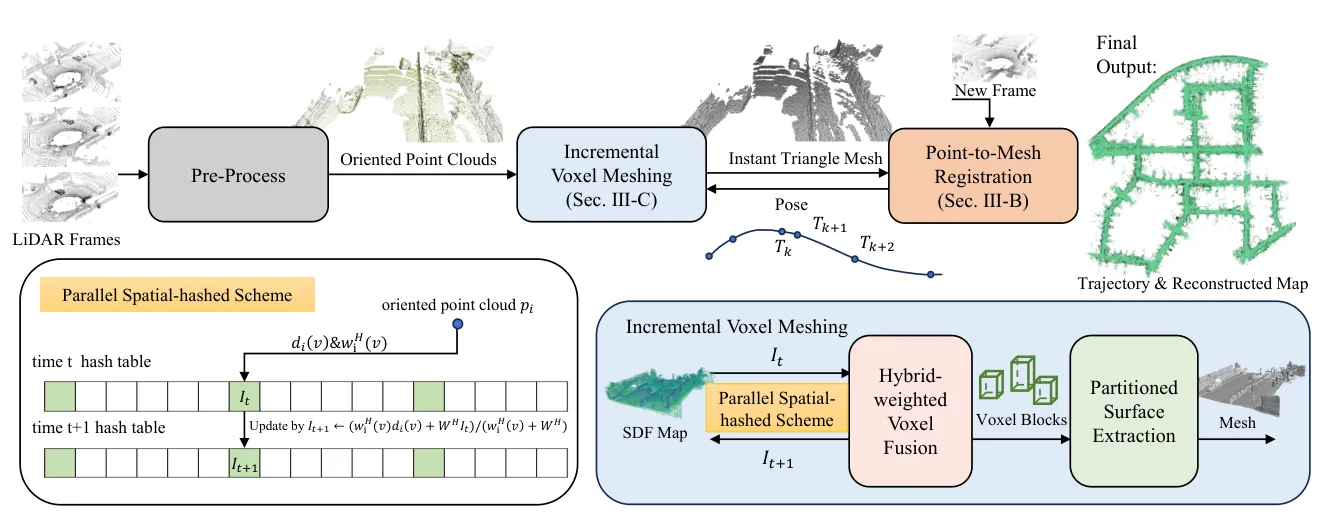
Mesh-LOAM 以隱式移動最小平方(IMLS)函數估計 SDF,但讓體素被動接收周圍點的 SDF 增量(passive voxel),避免逐體素搜尋近鄰,使每次掃描只需走訪各點一次;體素存於 GPU 平行空間雜湊表,並以 marching cubes 分區擷取網格。位姿以點對網格(point-to-mesh)里程計估計。
本頁內容
Real-time LiDAR odometry and meshing using an IMLS-based SDF accumulated in passive voxels on a GPU spatial hash, marching-cubes extraction and point-to-mesh odometry.
技術屬性
欄位內容為文獻擷取紀錄的原文用語(英文),以原文為據;「未查證」表示本研究尚未讀到該資訊,不代表該方法不具備此能力。
| 感測輸入 | 3D LiDAR |
|---|---|
| 原文測試平台 | vehicle、handheld、simulation |
| 狀態估計 | scan-to-mesh odometry minimising point-to-facet-plane residuals by Gauss-Newton on SE(3) for a relative correction applied to a constant-velocity pose prediction (Sec. III-B.3) |
| 資料關聯 | planar points (PCA curvature below 0.1) are transformed by a constant-velocity prediction and matched to mesh facets by nearest-neighbour search; a match is kept by point-to-facet distance and only if the absolute cosine similarity of point and facet normals exceeds 0.98 (Sec. III-B, IV-A) |
| 時間表示 | discrete poses |
| 去畸變 | 原文未報告 (LiDAR-only pipeline; no motion-compensation step described in arXiv v1) |
| 迴圈閉合 | none described (odometry and mapping only) |
| 全域最佳化 | none reported |
| 地圖表示 | sparse passive voxels (0.1 m) storing position, normal, IMLS-based SDF, weight and frame index, updated by hybrid distance and normal weights over a 3-voxel influence cube; GPU spatial hash with linear probing; height-adaptive voxel blocks with length and width set to 2 (unit not stated) for partitioned marching cubes; expired voxels converted to mesh and deleted to bound memory; marching cubes at dynamic intervals (Sec. III-C, III-D, IV-A) |
| 先驗資訊 | none |
| 可輸出幾何 | triangle mesh |
| 計算需求 | GPU-centred C++ and CUDA (Intel i7-9800X, RTX 2080 Ti 11 GB); on KITTI 07 per frame 4.85 ms preprocessing, 10.96 ms odometry, 2.68 ms meshing, 18.49 ms total (about 54 fps) with 442 MB CPU and 2860 MB GPU memory, versus 29.27 ms and 3014 MB for SLAMesh and 3307.50 ms and 5766 MB for Puma (VoR Table VIII, Sec. IV-F) |
使用設備
原文使用的感測器、運算硬體與載具(equipment)。型號保留原文寫法,連結到設備頁中同一型號的歸併名稱;角色依原文用途分為方法輸入、資料集感測器、執行運算平台、參考或真值量測(reference or ground truth)與比較對象設備。
| 類別 | 型號(原文寫法) | 角色 | 資料集 | 原文規格 | 出處 |
|---|---|---|---|---|---|
| LiDAR | Velodyne HDL-64E S2歸入:Velodyne HDL-64E | 資料集感測器 | KITTI Odometry | KITTI odometry sequences 00-10, 23,201 scans | (Zhu et al., 2025, Sec. IV-B) |
| LiDAR | Ouster OS0-64 | 資料集感測器 | Hilti SLAM Challenge 2021 | 360 deg field of view, 10 Hz; only this sensor's data used | (Zhu et al., 2025, Sec. IV-B; Sec. IV-C; Table III (VoR)) |
| LiDAR | virtual Velodyne HDL-64 LiDAR | 資料集感測器 | Mai City | synthetic urban-like scans (Mai City) | (Zhu et al., 2025, Sec. IV-B; Table IV (VoR)) |
| LiDAR | Ouster OS-1歸入:Ouster OS1 | 資料集感測器 | Newer College | multi-beam 3D LiDAR on a handheld device at Oxford; dataset provides a millimetre-accurate 3D map; NCD-QUAD sequence | (Zhu et al., 2025, Sec. IV-B; Table IV (VoR)) |
| 載具平台 | handheld sensor platform (Hilti 2021) | 資料集感測器 | Hilti SLAM Challenge 2021 | records the data and provides millimetre-accurate ground truth; most sequences have 3-DoF ground truth | (Zhu et al., 2025, Sec. IV-B) |
| 運算硬體 | Intel Core i7-9800X | 執行運算平台 | 未標示 | 3.80 GHz; the method runs mainly on the GPU except for data transmission | (Zhu et al., 2025, Sec. IV-A) |
| 運算硬體 | NVIDIA GeForce RTX 2080Ti歸入:NVIDIA Geforce RTX2080Ti | 執行運算平台 | 未標示 | 11 GB GPU RAM; the method runs mainly on the GPU | (Zhu et al., 2025, Sec. IV-A) |
論文圖片
只收錄原文以開放授權(open license)釋出的圖片,並依授權條件標示出處、圖號、授權與修改方式。
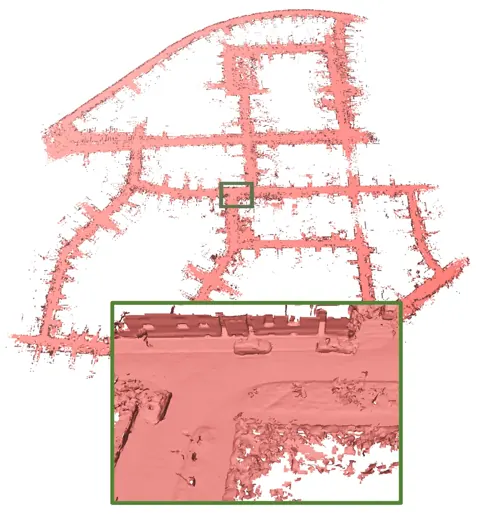
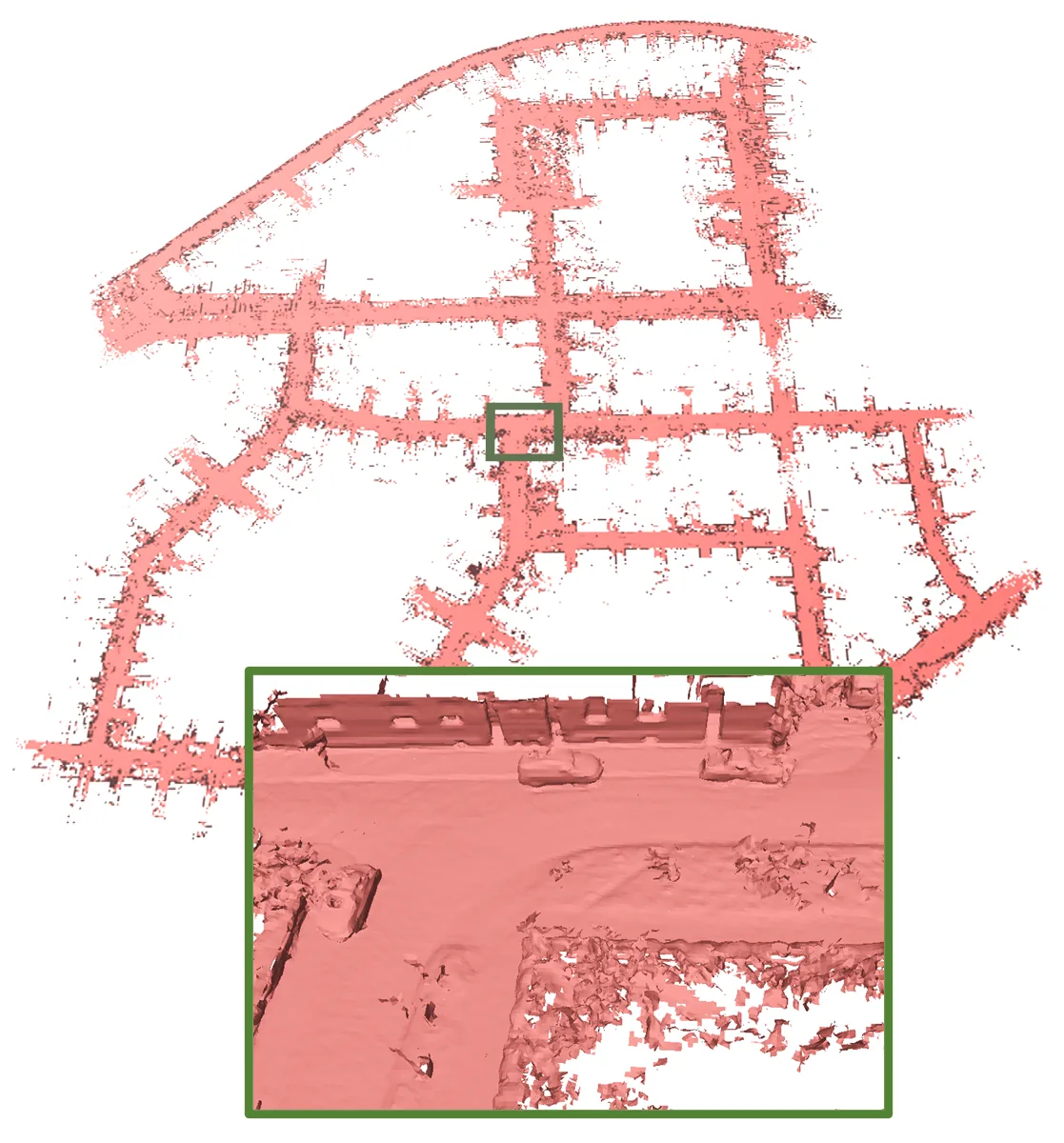
Fig. 1 (arXiv v1)KITTI 00 序列的里程計軌跡與大範圍網格地圖,全流程約 54 fps
出處:Zhu et al., 2025,Fig. 1 (arXiv v1)。授權:CC BY 4.0 (arXiv v1; version of record © IEEE)。原始圖檔。修改:轉存為 WebP 格式。
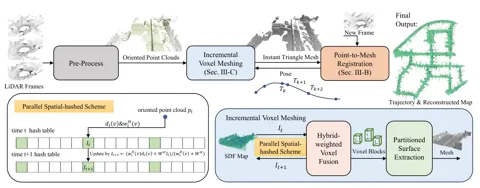
Fig. 2 (arXiv v1)系統總覽:PCA 法向量估計、增量體素網格化、平行空間雜湊與點對網格里程計
出處:Zhu et al., 2025,Fig. 2 (arXiv v1)。授權:CC BY 4.0 (arXiv v1; version of record © IEEE)。原始圖檔。修改:轉存為 WebP 格式。
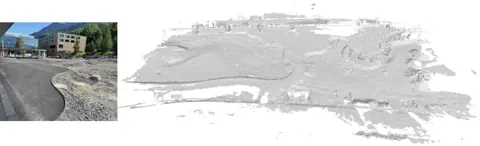
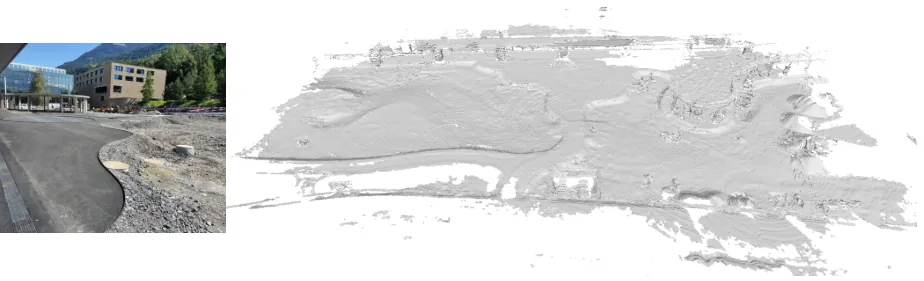
Fig. 10 (arXiv v1) = Fig. 8 (VoR)Hilti cons2 施工環境的現場照片與網格重建結果
出處:Zhu et al., 2025,Fig. 10 (arXiv v1) = Fig. 8 (VoR)。授權:CC BY 4.0 (arXiv v1; version of record © IEEE)。原始圖檔。修改:轉存為 WebP 格式。
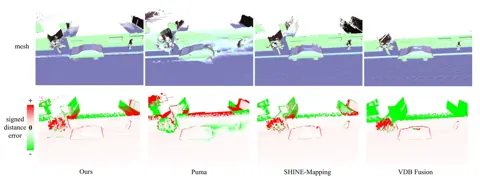
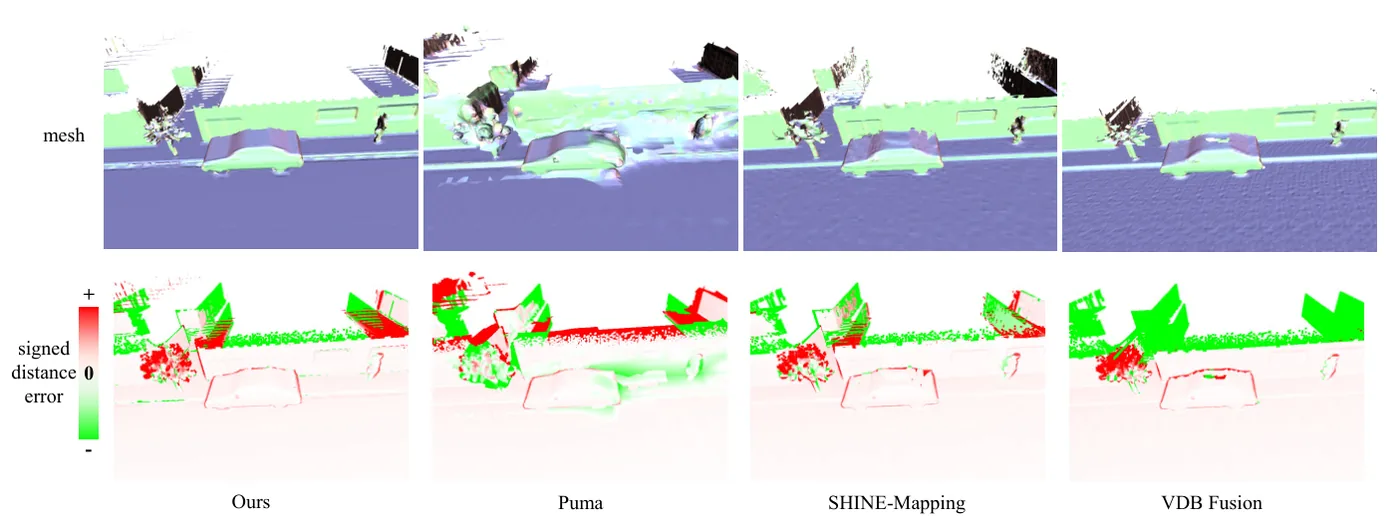
Fig. 11 (arXiv v1)Mai City 上 Mesh-LOAM、Puma、SHINE-Mapping 與 VDBFusion 的網格及有號距離誤差圖
出處:Zhu et al., 2025,Fig. 11 (arXiv v1)。授權:CC BY 4.0 (arXiv v1; version of record © IEEE)。原始圖檔。修改:縮小至寬度不超過 1400 px,並轉存為 WebP 格式。
作者報告的優勢與限制
優勢
- Authors argue implicit reconstruction is more robust to noise than the explicit meshing used by SLAMesh and ImMesh (Sec. I).
- On six Hilti 2021 sequences (Ouster OS0-64) ATE was lowest on Base1, Cons2 and Camp2 (0.165, 0.083, 0.113 m); SLAMesh was lower than Mesh-LOAM on RPG (0.165 m, the lowest) and Lab (0.048 m), SuMa had the lowest Lab value (0.045 m) although the table bolds SLAMesh, KISS-ICP was lowest on Base4 (0.119 m), and Puma failed on all six (VoR Table III).
- KITTI 00-10 mean relative error 0.51% and 0.14 deg/100 m, second to KISS-ICP at 0.50%, and mean ATE 2.3 m, the lowest of eight methods (VoR Tables I-II).
- With ground-truth poses and 0.1 m voxels, F-score 97.4 (10 cm) on Mai City and 94.1 (20 cm) on Newer College, above VDBFusion, Puma, SHINE-Mapping and SLAMesh (VoR Table V).
- Passive voxels cut the SDF map update from 8806.20 ms to 2.12 ms per frame on KITTI (VoR Table VI).
限制
- On KITTI, sequences 04-06 were worse than KISS-ICP, which the authors attribute to a 0.2 m search interval (Sec. IV-C).
- Requires an NVIDIA GPU; implemented in CUDA; 2860 MB of GPU memory on KITTI 07, and mesh simplification to reduce memory is future work (Sec. IV-A, IV-F, V).
- Hilti evaluation: caption gives ATE in m but the text says %, and the statistic and alignment are not reported (VoR Sec. IV-C, Table III).
- KITTI baselines partly imported from published papers (only DLO, KISS-ICP and FLOAM re-run), so settings are not uniform (VoR Sec. IV-C).
- Handheld data gives non-uniform coverage and blank mesh edges (Sec. IV-D); data association is the runtime bottleneck (Sec. IV-F); (inference) no loop-closure module is described.
營建工程相關證據
里程計在 Hilti 2021 的六條序列評估,其中僅 Cons2 屬資料集的施工現場環境(Helmberger et al. 2022 描述為大部分戶外、約 40 m x 80 m、未完成表面);Cons2 的 ATE 為 0.083 m,SLAMesh 0.339 m、KISS-ICP 0.835 m、SuMa 1.642 m、FLOAM 11.515 m,Puma 失敗(正式版 Table III)。Hilti 2021 真值多為 3 自由度位置。網格精度只在 Mai City(模擬)與 Newer College 以真值位姿評估;施工環境的網格僅作定性展示(正式版 Fig. 8,arXiv 版 Fig. 10),未在工地量化驗證。
原文驗證環境:公開基準、模擬、已完工建築、施工中工地
報告的性能數據
以下是原文作者報告的性能數值(author-reported results),不是本研究重新量測的結果。每張圖只並列同一個比較組(comparison group,同一張表、同一組實驗設定)內的方法;不同比較組之間的數值不可直接比較,也不構成排名。
本方法共出現在 7 個比較組,合計 40 筆紀錄。以下列出本方法紀錄最多的 4 組,其餘 3 組列在最後,並連到性能比較頁。
Zhu et al., 2025 · Table V 本方法 10 筆
表格設定(擷取紀錄原文):Mesh quality with ground-truth poses for all methods, voxel size 0.1 m, settings of SHINE-Mapping; distances in cm; completion ratio and F-score in % at 10 cm (Mai City) and 20 cm (Newer College) (Zhu et al., 2025, Table V)
Comp. (cm), completion,Mai City · Mai City
只並列這張表在相同設定下報告的方法;以「本方法:」開頭者為本頁方法。失敗、未執行與未報告以標記呈現,不是 0。
按 Tab 進入圖表後,用上下方向鍵逐一瀏覽各類別,Esc 關閉提示框;也可開啟表格檢視閱讀全部數值。
這些是 Zhu et al., 2025 在此表設定下報告的數值(author-reported results),只能在同一個比較組內對照,不代表方法在其他資料或設定下的表現。
資料來源作者報告值(Zhu et al., 2025, Table V)
| 方法(原文寫法) | 報告值 | 出處 |
|---|---|---|
| VDB Fusion [28] | 6.9 cm | (Zhu et al., 2025, Table V (VoR)) |
| Puma [13] | 32 cm | (Zhu et al., 2025, Table V (VoR)) |
| SHINE-Mapping [30] | 3.2 cm | (Zhu et al., 2025, Table V (VoR)) |
| SLAMesh [14] | 7.5 cm | (Zhu et al., 2025, Table V (VoR)) |
| Ours本方法原文提出 | 2.5 cm | (Zhu et al., 2025, Table V (VoR)) |
Zhu et al., 2025 · Table VI 本方法 10 筆
資料集與序列KITTI Odometry
表格設定(擷取紀錄原文):Ablation on KITTI odometry: per-frame computational cost (ms) of each module with the passive (proposed) versus active SDF estimation model; both GPU-accelerated (Zhu et al., 2025, Table VI)
Preprocess (ms),KITTI Odometry
只並列這張表在相同設定下報告的方法;以「本方法:」開頭者為本頁方法。失敗、未執行與未報告以標記呈現,不是 0。
按 Tab 進入圖表後,用上下方向鍵逐一瀏覽各類別,Esc 關閉提示框;也可開啟表格檢視閱讀全部數值。
這些是 Zhu et al., 2025 在此表設定下報告的數值(author-reported results),只能在同一個比較組內對照,不代表方法在其他資料或設定下的表現。
資料來源作者報告值(Zhu et al., 2025, Table VI)
| 方法(原文寫法) | 報告值 | 出處 |
|---|---|---|
| Mesh-LOAM with passive SDF computational model本方法原文提出硬體:Intel Core i7-9800X at 3.80 GHz with NVIDIA GeForce RTX 2080Ti (11 GB); Mesh-LOAM mainly on GPU, Puma and SLAMesh CPU-based (Sec. IV-A, IV-F) | 4.85 ms | (Zhu et al., 2025, Table VI (VoR)) |
| Mesh-LOAM with active SDF computational model本方法硬體:Intel Core i7-9800X at 3.80 GHz with NVIDIA GeForce RTX 2080Ti (11 GB); Mesh-LOAM mainly on GPU, Puma and SLAMesh CPU-based (Sec. IV-A, IV-F) | 5.18 ms | (Zhu et al., 2025, Table VI (VoR)) |
Zhu et al., 2025 · Table III 本方法 6 筆
指標ATE (m)
表格設定(擷取紀錄原文):Hilti SLAM Challenge 2021, Ouster OS0-64 data only; all methods run by the authors with their own implementations; caption gives ATE in m while the text says %; most sequences have 3-DoF ground truth; 'x' = failed registration (Zhu et al., 2025, Table III)
ATE (m),Hilti SLAM Challenge 2021 · RPG
只並列這張表在相同設定下報告的方法;以「本方法:」開頭者為本頁方法。失敗、未執行與未報告以標記呈現,不是 0。
- 失敗
按 Tab 進入圖表後,用上下方向鍵逐一瀏覽各類別,Esc 關閉提示框;也可開啟表格檢視閱讀全部數值。
這些是 Zhu et al., 2025 在此表設定下報告的數值(author-reported results),只能在同一個比較組內對照,不代表方法在其他資料或設定下的表現。
資料來源作者報告值(Zhu et al., 2025, Table III)
| 方法(原文寫法) | 報告值 | 出處 |
|---|---|---|
| SuMa [8] | 0.262 m | (Zhu et al., 2025, Table III (VoR)) |
| FLOAM [4] | 2.775 m | (Zhu et al., 2025, Table III (VoR)) |
| KISS-ICP [5] | 0.187 m | (Zhu et al., 2025, Table III (VoR)) |
| Puma [13] | 無數值失敗註記(擷取紀錄):failed | (Zhu et al., 2025, Table III (VoR)) |
| SLAMesh [14] | 0.165 m | (Zhu et al., 2025, Table III (VoR)) |
| Ours本方法原文提出 | 0.173 m | (Zhu et al., 2025, Table III (VoR)) |
Zhu et al., 2025 · Table VIII 本方法 6 筆
資料集與序列KITTI Odometry · 07
表格設定(擷取紀錄原文):KITTI sequence 07: per-frame computational time (ms) and peak memory (MB); Puma and SLAMesh are CPU-based; Mesh-LOAM allocates extra GPU memory for parallel operations (Zhu et al., 2025, Table VIII)
Preprocess (ms),KITTI Odometry · 07
只並列這張表在相同設定下報告的方法;以「本方法:」開頭者為本頁方法。失敗、未執行與未報告以標記呈現,不是 0。
按 Tab 進入圖表後,用上下方向鍵逐一瀏覽各類別,Esc 關閉提示框;也可開啟表格檢視閱讀全部數值。
這些是 Zhu et al., 2025 在此表設定下報告的數值(author-reported results),只能在同一個比較組內對照,不代表方法在其他資料或設定下的表現。
資料來源作者報告值(Zhu et al., 2025, Table VIII)
| 方法(原文寫法) | 報告值 | 出處 |
|---|---|---|
| Puma [13]硬體:Intel Core i7-9800X at 3.80 GHz with NVIDIA GeForce RTX 2080Ti (11 GB); Mesh-LOAM mainly on GPU, Puma and SLAMesh CPU-based (Sec. IV-A, IV-F) | 94 ms | (Zhu et al., 2025, Table VIII (VoR)) |
| SLAMesh [14]硬體:Intel Core i7-9800X at 3.80 GHz with NVIDIA GeForce RTX 2080Ti (11 GB); Mesh-LOAM mainly on GPU, Puma and SLAMesh CPU-based (Sec. IV-A, IV-F) | 5.18 ms | (Zhu et al., 2025, Table VIII (VoR)) |
| Ours本方法原文提出硬體:Intel Core i7-9800X at 3.80 GHz with NVIDIA GeForce RTX 2080Ti (11 GB); Mesh-LOAM mainly on GPU, Puma and SLAMesh CPU-based (Sec. IV-A, IV-F) | 4.85 ms | (Zhu et al., 2025, Table VIII (VoR)) |
其他比較組
來源
Zhu et al., 2025
(2025)Mesh-LOAM: Real-Time Mesh-Based LiDAR Odometry and MappingIEEE Transactions on Intelligent Vehicles, 10(1):24-35
DOI 10.1109/tiv.2024.3409085arXiv 2312.15630
同儕審查已出版已讀全文近十年查證後修正
相關版本
- 預印本:arXiv:2312.15630 (v1 2023-12-25) https://arxiv.org/abs/2312.15630